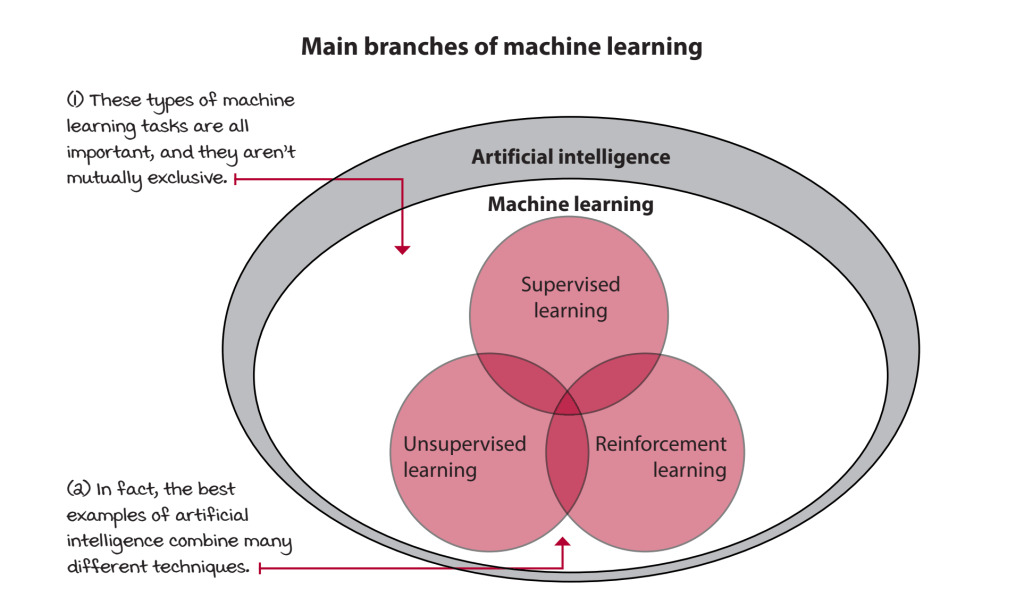
In the search for artificial general intelligence (AGI), which aims to redefine the boundaries of automation and computational problem-solving, machine learning (ML) plays a vital role. ML has three main branches: supervised, unsupervised, and reinforcement learning. Each approach provides valuable insights and capabilities for developing advanced AI systems. It’s important to understand the similarities, differences, and synergies between these methods, as it is essential for anyone seeking to harness the full power of AI.
Created by DALL.E 3
Understanding the Machine Learning Landscape
Machine learning, the driving force behind recent breakthroughs in AI, can be categorized into three primary branches, each with its own approach to learning and problem-solving.
Supervised Learning: Definitions and Key Characteristics Supervised learning stands as the most prevalent form of machine learning. It operates on a simple yet powerful premise: learning from labeled data. This approach involves training an algorithm on a dataset that contains input-output pairs, where the correct output (label) for each input is provided. The aim is to learn a mapping from inputs to outputs, enabling the model to make accurate predictions or decisions when presented with new, unseen data. Applications range from image recognition to predicting consumer behavior.
Unsupervised Learning: Exploring the Unknown Unlike its supervised counterpart, unsupervised learning dives into the realm of unlabeled data. This branch focuses on identifying underlying patterns, structures, or distributions in data without predefined labels or outcomes. Techniques such as clustering and dimensionality reduction are staples of unsupervised learning, helping to uncover hidden correlations and features that might not be immediately apparent. It’s particularly useful for exploratory data analysis, anomaly detection, and complex system modeling.
Reinforcement Learning: Learning Through Interaction Reinforcement learning (RL) distinguishes itself by focusing on how agents ought to take actions in an environment to maximize some notion of cumulative reward. It is about learning from interaction with the environment, through trial and error, rather than from a fixed dataset. RL is pivotal in scenarios where an agent must make a sequence of decisions under uncertainty, with applications ranging from robotics to game playing and beyond. This branch emphasizes the importance of exploration, adaptation, and the balancing act between exploiting known strategies and exploring new possibilities.
Source: Grokking Deep Reinforcement Learning Book by Miguel Morales
Each of these machine learning paradigms brings its own set of tools, perspectives, and methodologies to the table. Together, they form a comprehensive toolkit for tackling the diverse challenges encountered on the path to AGI. As we delve deeper into their similarities and collaborative potential, it becomes clear that the integration of these approaches could be key to unlocking more advanced and versatile AI solutions.
Continuing from where we left off, let’s explore the similarities across the branches of machine learning and how they can be integrated to foster progress towards artificial general intelligence (AGI).
Similarities Across the Branches
While supervised, unsupervised, and reinforcement learning each possess distinct characteristics and methodologies, they share common foundations and goals that underscore the unified pursuit of AGI.
Common Goals and Objectives At their core, all three branches of machine learning aim to enhance the decision-making capabilities of AI systems. Whether it’s through analyzing labeled datasets, uncovering hidden structures in data, or learning from interaction with an environment, each approach strives to improve the efficiency, accuracy, and adaptability of AI. This shared objective is a testament to the overarching mission of machine learning: to create algorithms capable of generalizing from their experiences, thus moving closer to the essence of human-like intelligence.
Data-Driven Insights Despite their methodological differences, supervised, unsupervised, and reinforcement learning all rely on data to derive insights and guide learning processes. This reliance on data as the cornerstone of learning and development highlights a fundamental similarity: the belief in data’s intrinsic value for teaching machines to recognize patterns, make predictions, and perform complex tasks. It underscores the importance of diverse, comprehensive datasets for advancing AI research and application, emphasizing a data-centric approach to achieving AGI.
Combining Forces for AGI
The path to AGI is fraught with complexities and challenges that no single machine learning branch can overcome on its own. By leveraging the strengths and compensating for the weaknesses of each approach, researchers can devise more robust, adaptable, and intelligent systems.
Integrative Strategies for Complex Problem Solving Combining supervised, unsupervised, and reinforcement learning can lead to innovative solutions for complex problems. For instance, supervised learning can be used to teach AI basic recognition tasks, while unsupervised learning can help it uncover underlying patterns and novel insights within large datasets. Reinforcement learning can then refine these capabilities, enabling the AI to interact with and adapt to dynamic environments. This collaborative approach not only broadens the scope of problems AI can solve but also enhances its learning efficiency and flexibility. For example, in autonomous driving, supervised learning can interpret road signs, unsupervised learning can detect unexpected obstacles, and reinforcement learning can make split-second navigation decisions.
Potential for Innovation and Advancement The integration of different learning paradigms opens up new avenues for innovation in AI. It encourages a more holistic view of machine learning, where the boundaries between disciplines blur, fostering cross-pollination of ideas and techniques. This convergence is crucial for the development of AGI, as it necessitates a blend of specialized knowledge and general adaptability. By drawing on the strengths of each machine learning branch, researchers can push the boundaries of what AI can achieve, accelerating the journey towards creating truly intelligent, general-purpose systems.
The search for artificial general intelligence is a complex challenge that requires a deep understanding and use of different types of machine learning. Supervised, unsupervised, and reinforcement learning each have their own strengths and perspectives. By combining these approaches, we can unlock the full potential of AI. By working together and using these tools, we can make significant progress in achieving AGI. As we explore and innovate, the collaborative use of these methods will lead to exciting advancements in artificial intelligence.